
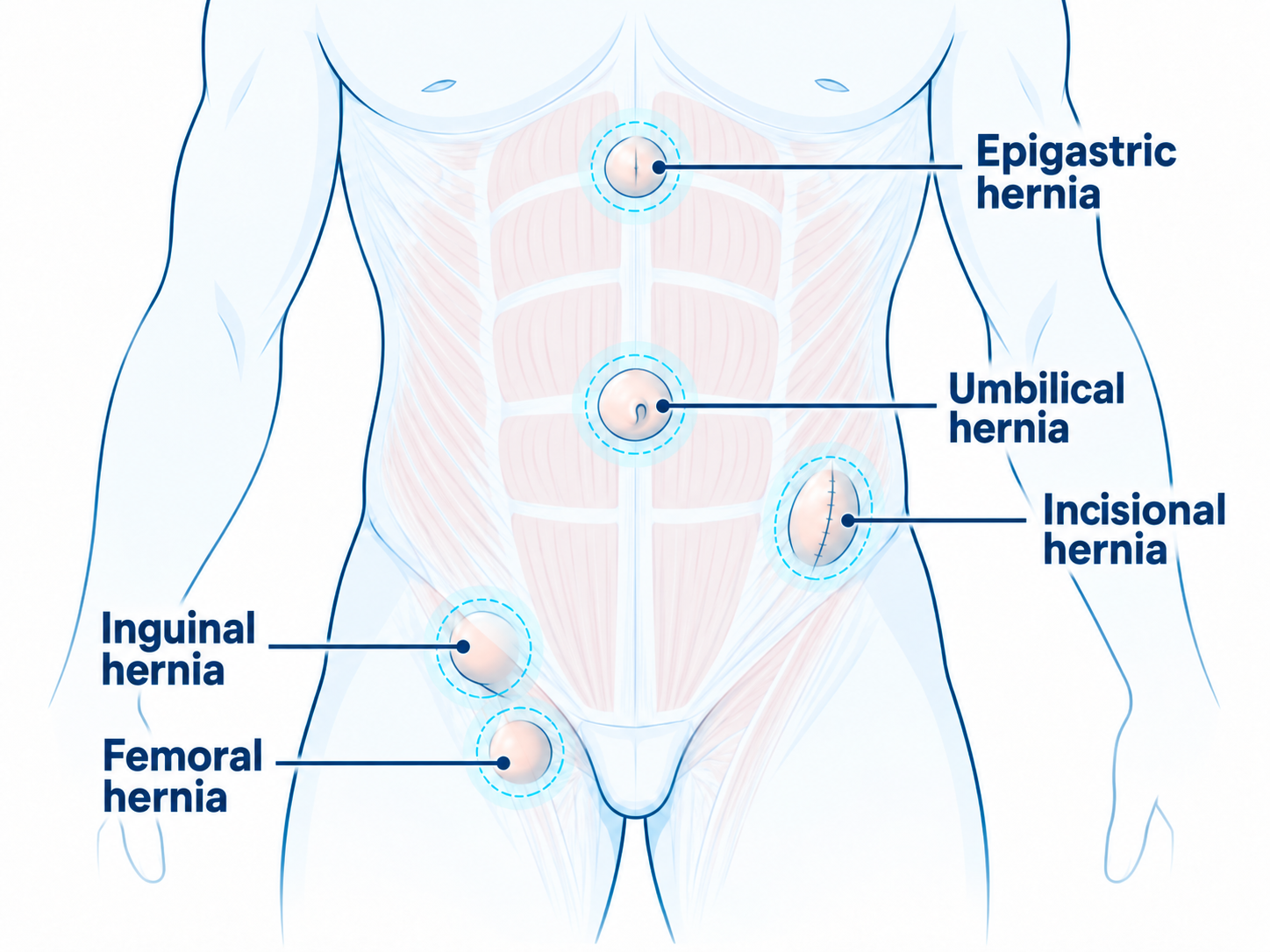
A hernia occurs when tissue pushes through a weakness or opening in the abdominal wall. Hernias are common, but the right management depends on the type of hernia, symptoms, overall health and the risk of complications.
Common types
- Inguinal and femoral hernias in the groin
- Umbilical and epigastric hernias
- Incisional hernias after previous abdominal surgery
- Recurrent hernias
- Parastomal and complex abdominal wall hernias
- Hiatus hernia, which is considered separately with reflux disease
Assessment
Many abdominal wall hernias can be diagnosed by examination. Ultrasound, CT or other imaging may be useful in selected cases, particularly for recurrent, incisional or complex hernias or where another diagnosis is possible.
Treatment
Some hernias can be observed safely, while others are better treated surgically because of symptoms, enlargement or the risk of complications. Complex, recurrent and large incisional hernias may require advanced repair and abdominal wall reconstruction. Repair may be open, laparoscopic or robotic where appropriate. Mesh can be useful in some repairs but is not appropriate in every situation; the approach should be individualised.
When to seek urgent help
A hernia that becomes suddenly painful, firm, tender or cannot be pushed back — particularly with vomiting, abdominal distension or inability to pass wind or stool — can represent obstruction or strangulation and needs urgent assessment.